


【News & Topics】 2026.06.24
A student from our university received the Young Researcher Outstanding Presentation Fellow Award at the 79th Annual Meeting of the Kyushu Branch of the Japan Society of Mechanical Engineers
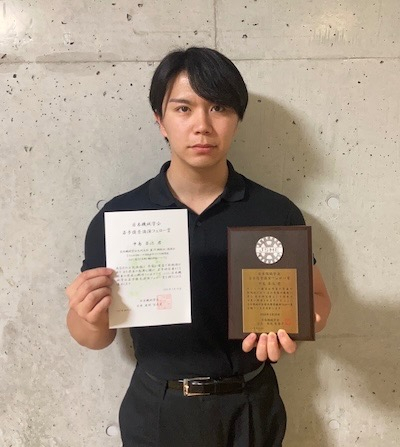
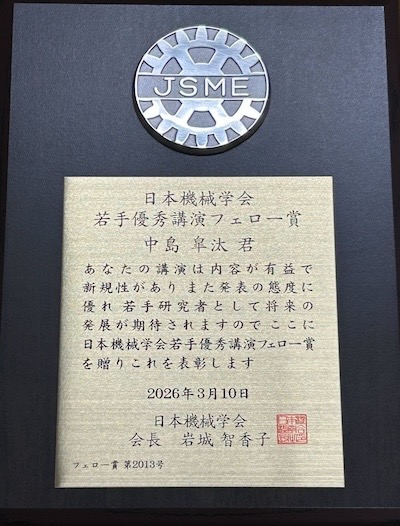
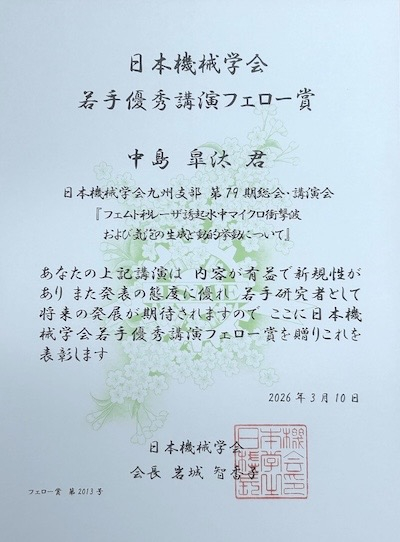
On March 10, 2026, the 79th General Meeting of the Kyushu Branch of the Japan Society of Mechanical Engineers was held at Nagasaki University. At the meeting, Kota Nakajima, a second-year master's student in the Masaaki Tamagawa Laboratory, Department of Applied Biomedical Engineering, Graduate School of Biomedical Engineering, Nagasaki University, and his colleagues received the Young Researcher Outstanding Presentation Fellow Award, Japan Society of Mechnaical Engineer for their oral presentation (title: On the generation and dynamic behavior of femtosecond laser-induced micro-shock waves and bubbles in water). This award is given to members who are under 26 years old as of April 1st of the following year, and is awarded to approximately 1 in 20 eligible members. The award consists of a plaque and a certificate in catalog form that includes the presentation title and the name of the presentation.
Femtosecond lasers can generate microscale shock waves (microshock waves) near the focal point while minimizing thermal damage.Therefore they are expected to be utilized as a source of mechanical stimulation in regenerative medicine. However, many aspects of the generation and propagation behavior of femtosecond laser-induced microshock waves, as well as their relationship with the dynamic behavior of bubbles formed near the focal point, remain unclear. In particular, controlling these phenomena is a major challenge for medical applications involving blood and biological fluids as the surrounding medium.
In this study, microshock waves and laser-induced bubbles generated by focused femtosecond laser irradiation in liquids with different viscosities, including water, were visualized using a high-temporal-resolution shadowgraph method with nanosecond-pulse illumination. For the first time, the results revealed the effects of liquid viscosity on shock-wave propagation characteristics and on bubble dynamics, including their generation, expansion, and collapse behaviors.